
Ankle Ligament Injury: Types, Symptoms, and Effective Physiotherapy Treatment

A ankle ligament injury is one of the most common yet underestimated musculoskeletal conditions seen in clinical practice. While many people dismiss a twisted ankle as minor, ligament injuries can significantly affect stability, mobility, and long-term joint health if not properly treated.
Whether you are an athlete, an active individual, or someone who simply misstepped on uneven ground, understanding the nature of an ankle ligament injury is crucial. More importantly, knowing when to seek physiotherapy intervention can make the difference between a smooth recovery and chronic instability.
In this article, we examine the types of ligament injuries affecting the ankle and ankle, the key symptoms to watch for, and the most effective evidence-based physiotherapy treatments available today.

Role of Ankle Ligaments
Ligaments are dense bands of connective tissue that connect bones to one another. In the ankle and ankle complex, they provide structural stability while allowing controlled movement. Without healthy ligaments, even simple tasks such as walking, climbing stairs, or pivoting would become unstable and painful.
The lateral ankle ligaments, particularly the anterior talofibular ligament (ATFL), are the most frequently injured structures in the lower limb. Research consistently shows that ankle ligament injuries account for a significant proportion of sports-related injuries worldwide (Doherty et al., 2014). Furthermore, systematic reviews confirm that improper management increases the risk of chronic ankle instability (Kerkhoffs et al., 2012).
Therefore, an ankle ligament injury should never be ignored.
Types of Ankle Ligament Injury
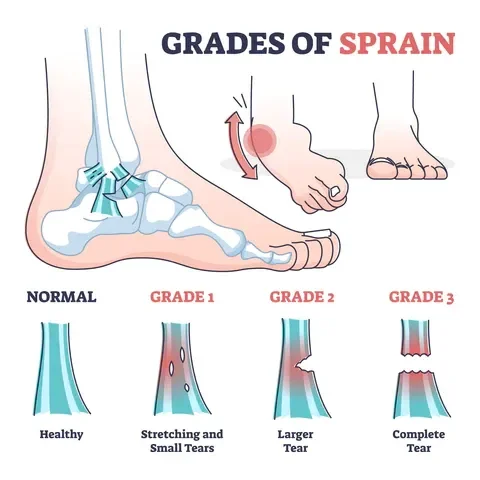
Clinically, an ankle ligament injury is graded according to severity. This classification helps guide treatment decisions and recovery timelines.
Grade I: Mild Sprain
A mild injury involves overstretching of the ligament fibres without significant tearing. A sprained ligament in the ankle at this stage typically presents with mild swelling, local tenderness, and slight discomfort when bearing weight. Joint stability is generally preserved.
Although symptoms may appear minor, early rehabilitation remains important to prevent recurrence.
Grade II: Partial Tear
A moderate sprained ligament in ankle involves partial tearing of the ligament fibres. Patients often experience noticeable swelling, bruising, and difficulty walking. There may also be a feeling of instability during weight-bearing activities.
At this stage, structured physiotherapy becomes essential to restore strength, proprioception, and joint control.
Grade III: Complete Rupture
A torn ligament in the ankle refers to a complete rupture. This is characterised by significant swelling, marked bruising, severe pain, and joint instability. In some cases, patients report hearing a “pop” at the moment of injury.
Although complete tears are more severe, many still respond well to comprehensive conservative physiotherapy management, depending on patient factors and functional demands.
Common Causes of a Sprained Ligament in Ankle
A sprained ligament in the ankle most often occurs during sudden inversion, where the ankle rolls inward unexpectedly. However, several contributing factors increase injury risk.
These include:
Participation in high-impact sports
Running on uneven surfaces
Wearing unsupportive footwear
Previous ankle injuries
Poor balance or neuromuscular control
Importantly, research shows that individuals who have sustained one ankle sprain are significantly more likely to experience another (Doherty et al., 2014). This highlights the need for complete rehabilitation rather than symptomatic relief alone.
Symptoms of a Torn Ligament in Ankle

While mild sprains may resolve quickly, a torn ligament in the ankle presents more dramatically. Recognising the symptoms early allows for timely intervention.
Common signs include swelling that develops rapidly after injury, bruising within hours, difficulty bearing weight, and a sensation of joint instability. In more severe cases, pain may persist beyond several days and worsen with movement.
If symptoms do not improve within 48 to 72 hours, a professional assessment is strongly advised. Delayed treatment increases the risk of chronic mechanical instability and prolonged dysfunction.
Why Early Physiotherapy Treatment Matters
Historically, ligament injuries were treated with prolonged immobilisation. However, modern evidence strongly supports early functional rehabilitation over complete rest (Kerkhoffs et al., 2012).
Immobilisation alone can lead to stiffness, muscle weakness, and delayed recovery. In contrast, progressive loading under professional supervision stimulates collagen healing, restores neuromuscular control, and improves long-term outcomes.
Therefore, the management of an Ankle ligament injury should follow a structured rehabilitation pathway.
Evidence-Based Physiotherapy Treatment for Ankle Ligament Injury
Effective physiotherapy treatment is tailored to the stage and severity of injury. A comprehensive rehabilitation programme typically progresses through three phases.
Phase 1: Acute Management
In the first few days, the focus is on protecting the ligament while minimising swelling and pain. The POLICE principle—Protection, Optimal Loading, Ice, Compression, and Elevation—is commonly applied.
Gentle joint mobilisation and controlled range-of-motion exercises may be introduced early to prevent stiffness and promote circulation. Importantly, complete inactivity is discouraged unless medically indicated.
Phase 2: Strength Restoration and Neuromuscular Control
Once acute inflammation subsides, attention shifts to rebuilding strength and joint stability. At this stage, rehabilitation becomes more active and progressive.
Targeted strengthening of the peroneal muscles, calf complex, and intrinsic ankle muscles helps reduce stress on healing ligaments. Additionally, proprioceptive training, such as single-leg balance exercises, plays a critical role in preventing recurrence.
Research consistently demonstrates that balance training significantly reduces future ankle sprains (Kerkhoffs et al., 2012).
For individuals experiencing muscular tightness or compensatory strain, adjunctive therapies such as professional sports massage therapy may support circulation and recovery. You can learn more about this approach here.
Phase 3: Functional and Return-to-Sport Training
The final stage prepares patients to safely resume daily activities or sports participation. This phase may include agility drills, controlled plyometrics, and sport-specific movement retraining.
Comprehensive musculoskeletal physiotherapy assessment ensures that biomechanical faults contributing to the initial injury are corrected. Gait analysis, movement screening, and strength symmetry testing help minimise reinjury risk. Explore specialised musculoskeletal care here.
When Is Surgery Required?
Most cases of ankle ligament injury, including many instances of a torn ligament in the ankle, can be managed successfully without surgery. However, surgical referral may be considered if there is persistent instability despite structured rehabilitation, associated fractures, or significant cartilage damage.
Current evidence supports conservative physiotherapy as the first-line treatment for acute ankle ligament injuries (Kerkhoffs et al., 2012).
Recovery Timeline for Ankle Ligament Injury
Recovery varies depending on severity:
Mild sprains may recover within two to four weeks
Moderate injuries typically require four to eight weeks
Complete tears may require eight to twelve weeks or longer
However, returning to activity prematurely increases the likelihood of reinjury. Objective functional testing should guide return-to-sport decisions.
Preventing Future Ankle Ligament Injuries
Prevention strategies are especially important for individuals with a history of ankle sprains.
Regular strengthening exercises, balance training, supportive footwear, and proper warm-up routines significantly reduce injury risk. Moreover, addressing minor symptoms early prevents progression from a mild sprained ligament in the ankle to a more serious torn ligament in ankle.
Consistent rehabilitation is the key to long-term joint health.
An ankle ligament injury may initially seem minor, yet its impact on mobility and stability can be substantial if not managed appropriately. Whether the injury involves a mild sprained ligament in the ankle or a complete torn ligament in the ankle, early assessment and structured physiotherapy treatment are essential.
Modern research clearly supports functional rehabilitation as the gold standard for recovery. With expert guidance, most patients regain full strength, confidence, and return safely to their desired level of activity.
If you are experiencing persistent swelling, instability, or ankle pain following an injury, seeking timely professional care can prevent long-term complications and accelerate your recovery.
Your feet form the foundation of movement. Investing in proper treatment today ensures stability, performance, and long-term joint health tomorrow.
Studies
Doherty, C. et al. (2014). Ankle ligament injuries.
Kerkhoffs, G.M. et al. (2012). Treatment of acute ankle ligament injuries: a systematic review.
Li, X. et al. (2023). Progress in diagnosis and treatment of acute injury to the anterior talofibular ligament.
Zhai, Y. et al. (2024). Ligamentous ankle injuries in relation to the morphology of the incisura fibularis: A systematic review.
Cleveland Clinic (2023). Foot Ligaments.